 HWAMDA

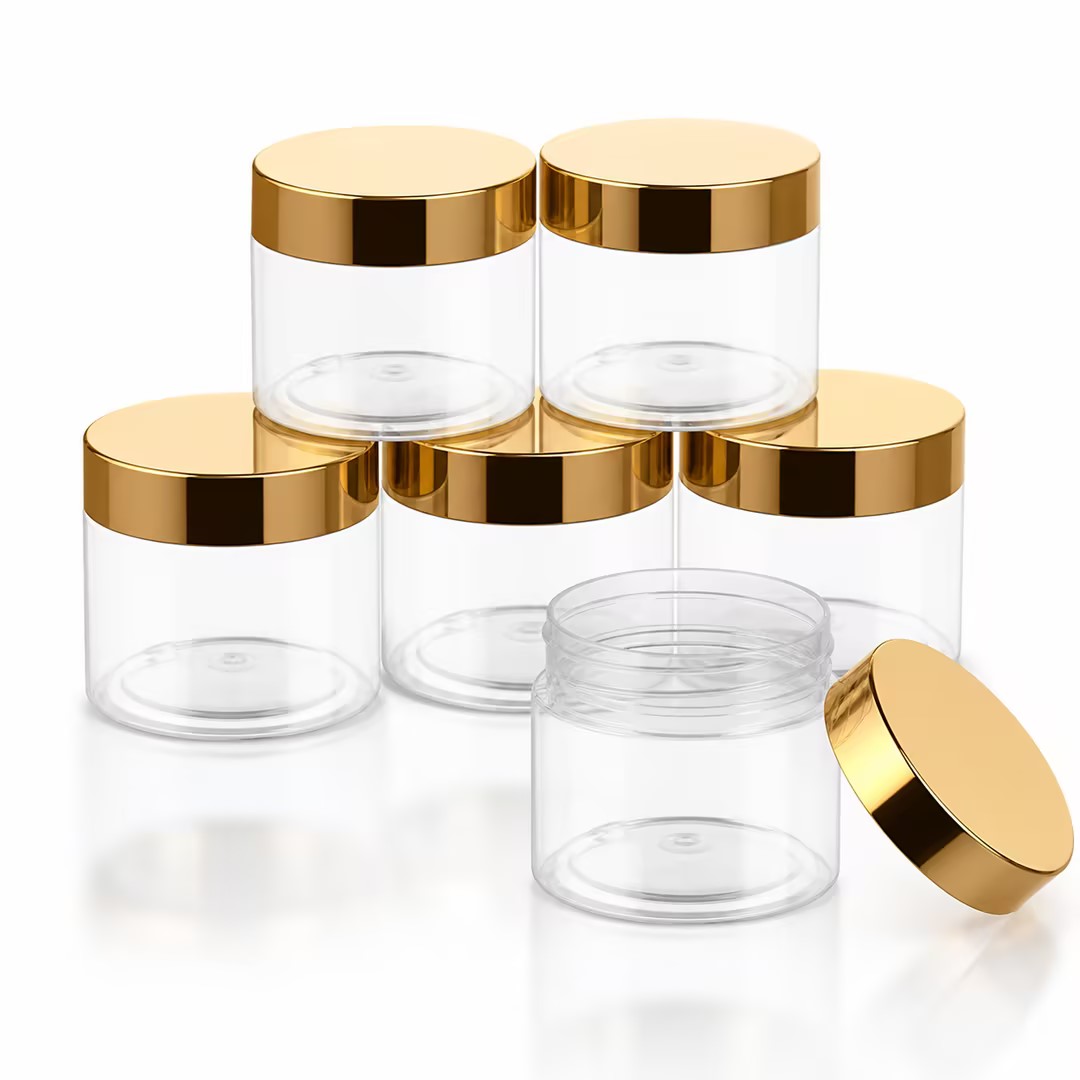
Cosmetic packaging products
Cosmetic packaging sells the product on the shelf. Customers notice gloss, color, transparency and the feel of a closing cap, so these parts combine tight tolerances with high visual standards.
- Caps and closures
- Screw caps, flip-top caps, pump collars and overcaps for bottles and tubes.
- Jars and lids
- Cream jars with thick, transparent or double-wall designs and matching lids.
- Compact cases
- Powder and eyeshadow compacts with hinges, mirrors and magnetic or snap closures.
- Lipstick and mascara tubes
- Multi-part assemblies of inner mechanism, base and cap with precise fits.
- Small accessories
- Inner plugs, sifters, applicator holders and spatulas.
Materials
| Material | Typical parts | Processing notes |
|---|---|---|
| PP | Caps, flip-tops, jars, inner parts | Easy flow, good hinge properties; nucleated grades for faster cycles |
| PETG | Thick-wall transparent jars and bottles | Dry approx. 65 °C for 4–6 h; clear thick walls need controlled cooling |
| ABS | Compacts, lipstick tubes, caps for metallizing | Dry approx. 80 °C for 2–4 h; good for plating and painting |
| Acrylic (PMMA) | Premium jars, lids and transparent caps | Dry approx. 80–90 °C for 3–4 h; sensitive to stress and flow marks |
| SAN / AS | Transparent caps and jars | Rigid and clear; dry before processing |
Confirm drying conditions with your resin supplier for the exact grade.
Process challenges
- Surface finish
- High-gloss and transparent parts show flow marks, jetting, weld lines and contamination. Controlled injection speed profiles and clean material handling are needed.
- Color consistency
- Brand colors must match from batch to batch. Accurate masterbatch dosing and stable melt temperature keep shade variation low.
- Thick-wall transparency
- Thick PETG and acrylic jars risk voids, sink marks and internal stress; long hold times and careful cooling help.
- Precision fits
- Threads, hinges and snap fits need stable shot-to-shot repeatability so caps open and close with the same feel.
- Clean handling
- Parts must not be scratched or contaminated; robot take-out and clean conveying protect the surface.
Typical quality checks
- Visual inspection
- Inspection under defined lighting for gloss, scratches, black specks, flow marks and bubbles in transparent parts.
- Color measurement
- Comparison against the approved color standard, often measured with a spectrophotometer.
- Fit and function
- Thread torque, cap opening force, hinge function and assembly fit with bottles, pumps and inner parts.
- Dimensions and weight
- Critical dimensions and shot weight checked regularly to confirm process stability.
- Decoration compatibility
- Surface ready for metallizing, hot stamping, printing or spraying without adhesion problems.
Typical configurations
The M8-SII-P series is configured for cosmetic packaging production, with attention to surface quality, color consistency and repeatability. A typical cell adds a dehumidifying or hot-air dryer for PETG, ABS or acrylic, a mold temperature controller, a closed vacuum loader to keep material clean, color dosing and a robot for careful part removal. Two-color caps and multi-material components can be produced on the DP multi-material series.
Cavity count is planned around part size and output. Small caps and inner plugs often run in 8 to 32 cavity molds, while premium jars and compacts with high appearance standards usually run in fewer cavities to keep filling and cooling uniform. Hot runner molds with valve gates are common on visible surfaces to avoid gate vestiges.
Decoration and secondary operations
Many cosmetic parts are decorated after molding by vacuum metallizing, UV coating, hot stamping, silk screen printing or spraying. Molding quality directly affects decoration results: residual stress, mold release agents and surface defects show clearly after metallizing. Planning the decoration route at the start helps define material grade, mold surface and handling, so parts reach the decoration line clean and stress-free.
How to start
Send part drawings or samples, the material grade, part weight, appearance standard, decoration plan such as metallizing or hot stamping, cavity count and target output. Models and specifications are provided with the configuration proposal.
FAQ
Frequently asked questions
Which materials are common for cosmetic jars?
PETG, acrylic and SAN are used for transparent premium jars; PP is common for standard jars and inner parts.
How do you avoid flow marks on glossy cosmetic parts?
Controlled multi-stage injection speed, correct melt and mold temperatures, well-dried material and good gate design reduce flow marks and jetting.
Can two-color caps be molded in one cycle?
Yes, two-color and multi-material caps can be produced on the DP multi-material series with a suitable rotary mold.
Do cosmetic materials need drying?
PETG, ABS, acrylic and SAN need drying before molding to avoid splay and haze; PP usually does not.
What should I send for a cosmetic packaging project?
Part drawings or samples, material, weight, appearance standard, decoration plan, cavities and target output.