 HWAMDA
Part & material
Share geometry, weight, wall thickness and resin grade.
Models
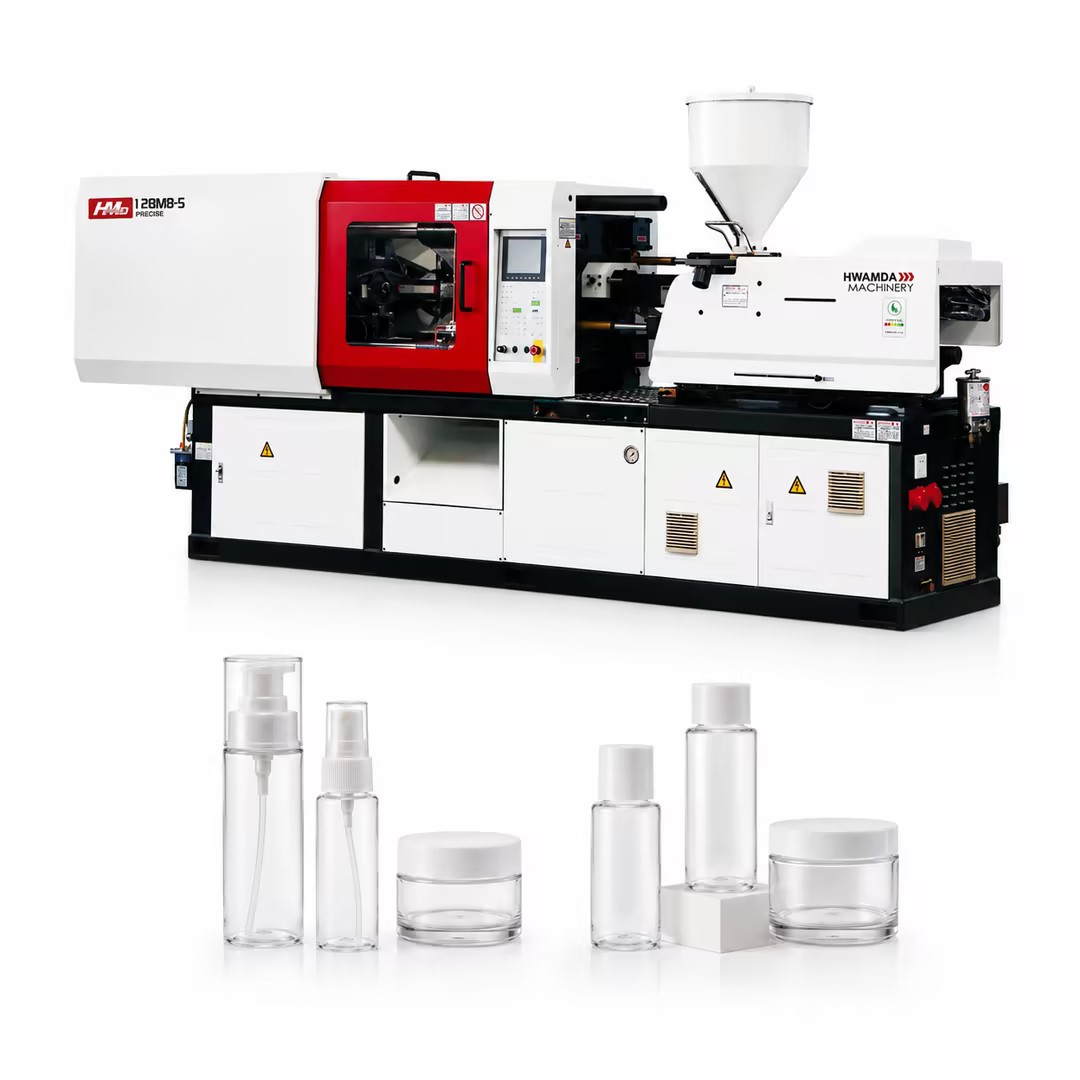
M8-SII-P injection molding machines configured for cosmetic caps, jars, compacts and tubes, with focus on surface finish and color consistency.
PRODUCTION REQUIREMENTS
Plan your M8-SII-P cosmetic packaging configuration around surface finish, color consistency and dimensional requirements. Share your part drawings, resin grade and mold details to discuss machine matching and part handling.
Share geometry, weight, wall thickness and resin grade.
Confirm mold size, runner, cavity count and interface requirements.
Define the target cycle, pieces per hour and finished-part handling.
Cosmetic packaging is judged by eye and by hand. A cap that looks perfect but closes with a different feel, or a jar with a slight color shift, can be rejected by the brand owner. The machine has to deliver repeatable shots, controlled filling and clean handling over long production runs.
| Defect | Typical cause | Machine-side control |
|---|---|---|
| Flow marks and jetting | Injection too fast at the gate | Multi-stage injection speed profile |
| Silver streaks and splay | Moisture in PETG, ABS or acrylic | Correct drying and closed loading |
| Color variation | Unstable dosing or melt temperature | Stable plasticizing and temperature control |
| Sink marks in thick walls | Insufficient holding pressure or time | Holding pressure profile and cooling time |
| Scratches and marks | Manual handling or part drop | Robot take-out and gentle conveying |
The M8-SII-P series is built on the M8SII servo-hydraulic platform and configured for cosmetic packaging. Configuration starts from the part: geometry, weight, material, appearance standard and cavity count decide the clamping force, injection unit and screw design. The mold dimensions and the take-out method complete the selection.
A typical cell includes a dryer suited to the resin, a mold temperature controller, a closed loading system, color dosing and a robot for part removal. Models and specifications are provided with the configuration proposal for your project. For two-color caps and multi-material parts, see the DP multi-material series.
See the complete cosmetic packaging production lineSend part drawings or samples, material grade, part weight, appearance and color standards, mold dimensions or cavity plan, decoration route and target output. A sales engineer will return a configuration proposal for the M8-SII-P cell.
FAQ
Yes. The series is configured for cosmetic parts including transparent PETG and acrylic jars, with drying and temperature control planned for the material.
Models and specifications are provided with the configuration proposal, based on your part, mold and output requirements.
Yes. Select the machine for the largest mold and heaviest shot, and the same machine can run a range of cosmetic molds.
Typically a dryer, mold temperature controller, closed vacuum loader, color dosing unit and a take-out robot.
Send the information you already have. We can help structure missing technical inputs.