 HWAMDA
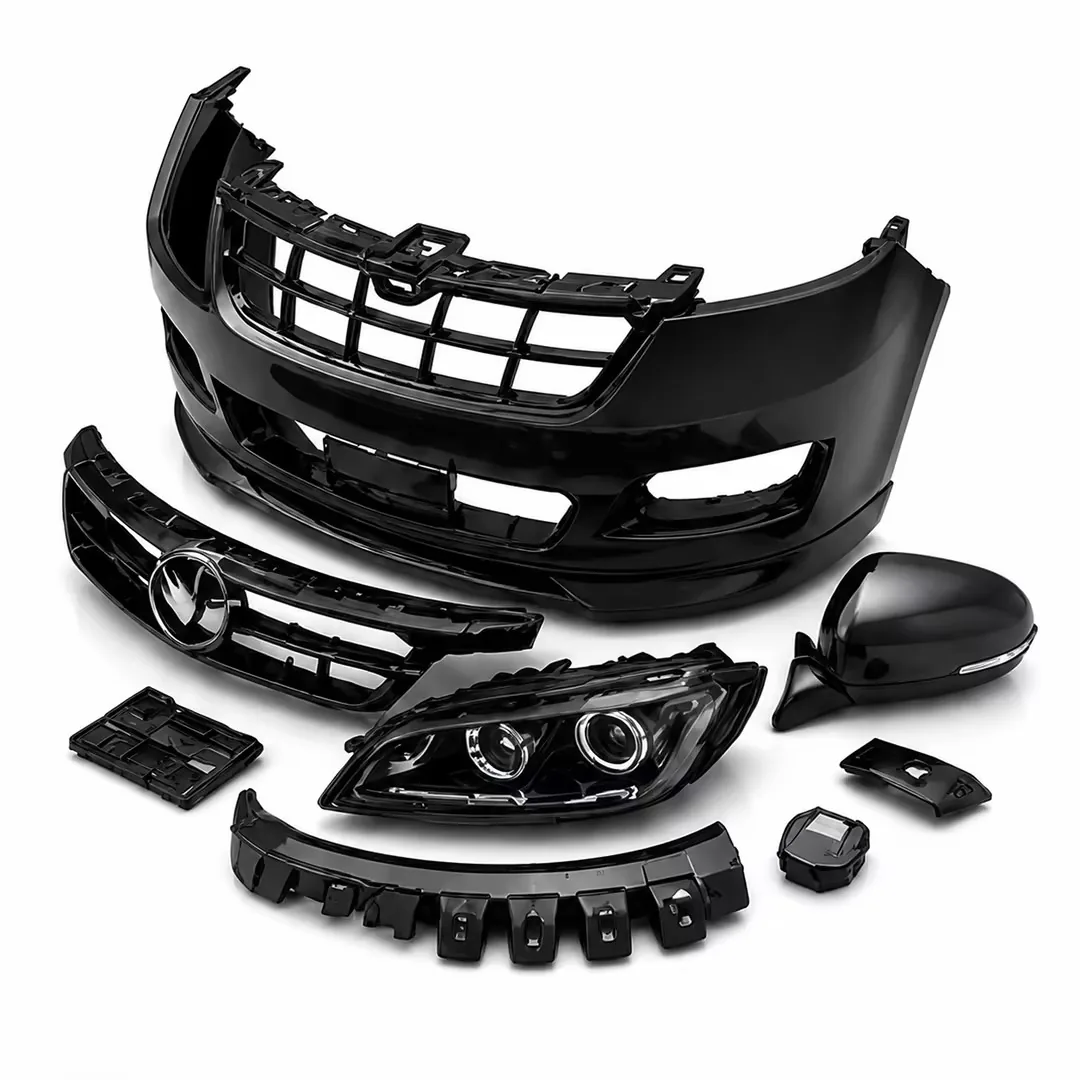
Typical automotive plastic parts
Automotive programs cover a wide range of part sizes, from a few grams to several kilograms. The machine is matched to the mold footprint, shot weight and appearance requirements of each part family.
- Interior trim and door panels
- Large, grained surfaces in PP or ABS where gloss uniformity and flow lines are inspected visually.
- Instrument-panel parts
- Carriers, vents and bezels that combine structural ribs with visible surfaces and tight assembly fits.
- Bumpers and large exterior parts
- Heavy molds and long flow paths that need high clamp force, large platens and long opening strokes.
- Under-hood parts
- Glass-filled PA or PBT parts such as covers, brackets and fluid components exposed to heat and oil.
- Connectors and clips
- Small precision parts in PA, PBT or POM, usually in multi-cavity molds with tight dimensional control.
- Lamp housings
- PP or PC/ABS housings where sealing surfaces and flatness must match the lens assembly.
Typical automotive materials
| Material | Typical uses | Typical processing notes |
|---|---|---|
| PP, PP-TD, PP-EPDM | Bumpers, door panels, interior trim | Melt 200–250 °C; talc and EPDM grades reduce shrinkage and improve impact |
| ABS | Trim, consoles, grilles | Dry 80 °C for 2–4 h; melt 220–260 °C |
| PC/ABS | Instrument-panel parts, lamp housings | Dry 100–110 °C for 3–4 h; melt 250–280 °C |
| PA6 / PA66-GF | Under-hood brackets, covers, connectors | Dry 80 °C to below 0.2% moisture; melt 260–300 °C; hot mold for fiber surface |
| POM | Clips, gears, fuel-system parts | Melt 190–220 °C; avoid long residence to prevent formaldehyde release |
| PBT | Connectors, sensor housings | Dry 120 °C for 3–4 h; melt 240–270 °C |
Typical values; confirm settings with your material supplier's datasheet.
Large-part considerations
Bumpers, door panels and instrument-panel carriers typically need 10,000 to 30,000 kN of clamp force, with molds that can exceed 2 m in width and weigh 20 tonnes or more. Platen size and daylight often decide the machine before tonnage does.
The DU II two-platen series covers 6,500 to 33,000 kN, from the DU650II to the DU3300II. The two-platen design gives a compact footprint for its clamp force, long opening strokes for deep parts and large platens for wide molds. For mid-size parts, the M8SII servo-hydraulic series covers 900 to 33,000 kN with several injection-unit options per model.
Inserts and multi-material molding
Many automotive parts combine a rigid substrate with a soft seal or grip, or embed metal inserts and terminals. Two- and three-material parts such as lamp components, knobs and sealed housings can run on the DP multi-material series, which spans 2,180 to 8,000 kN. Insert loading is usually handled by a robot so the cycle stays repeatable.
Quality focus
- Appearance
- Stable injection speed profiles and mold temperature control limit flow lines, gloss variation and sink on visible surfaces.
- Warpage
- Balanced cooling, consistent holding pressure and correct drying of glass-filled grades keep large parts flat.
- Fit
- Repeatable shot weight and clamp parallelism hold the dimensions that control gaps and flush with mating parts.
Project brief checklist
- Part data
- 3D files, part weight, projected area and appearance class.
- Material
- Grade, filler content and drying requirements.
- Mold
- Dimensions, weight, opening stroke, hot runner zones and core pulls.
- Output
- Target cycle time and annual volume.
- Automation
- Insert loading, robot take-out and downstream handling.
- Acceptance
- Dimensional, appearance and trial requirements agreed for the project.
FAQ
Frequently asked questions
What clamp force does a car bumper mold need?
Typical bumper molds need roughly 15,000 to 30,000 kN, depending on projected area, wall thickness and material. Mold width and opening stroke are checked alongside tonnage, which is why bumpers usually run on two-platen machines such as the DU II series.
Why choose a two-platen machine for large automotive parts?
Two-platen machines offer large platens and long strokes in a shorter footprint than a toggle or three-platen machine of the same clamp force. That suits deep, wide molds for bumpers, door panels and instrument-panel carriers.
Which series fits connectors and clips?
Small precision parts in PA, PBT or POM usually run on the M8SII servo-hydraulic series, sized to the mold and shot weight. Use the tonnage and shot size calculators for a first estimate.
Can parts with soft seals or two colors be produced in one cycle?
Yes. The DP multi-material series supports two- or three-color and material molding, with models from 2,180 to 8,000 kN.
Can we run a trial with our mold before shipment?
A factory trial before shipment can be arranged against the acceptance requirements agreed in the project. Share your mold data and material in the project brief to plan it.