 HWAMDA
What is a PET preform?
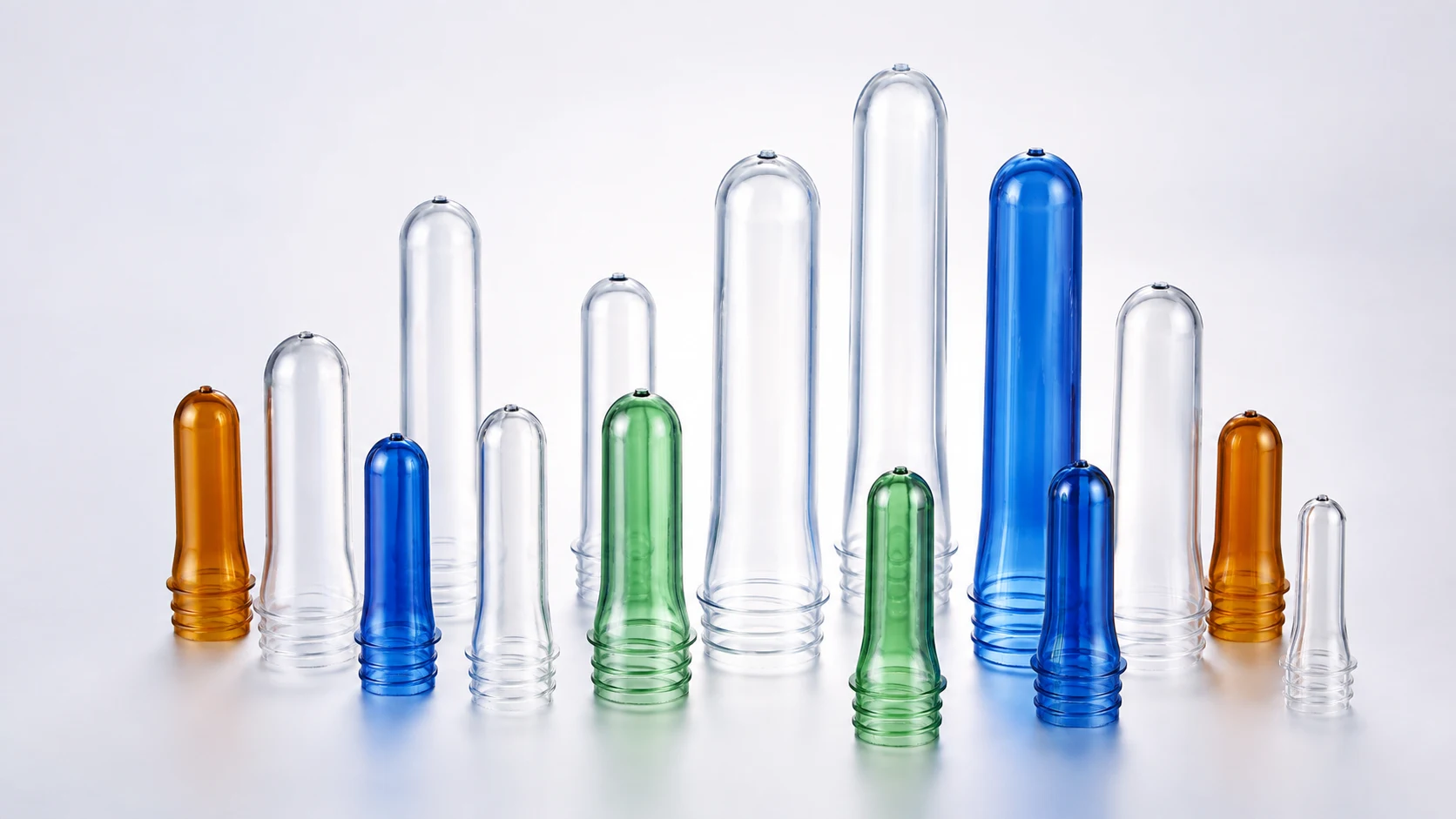
A PET preform is a small, test-tube-shaped part molded from polyethylene terephthalate (PET) resin. It already has the finished neck and thread of a bottle, but its body is short and thick-walled. In a second step, the preform is reheated and stretch-blow molded into the final bottle or jar.
Making a bottle in two stages separates precise work from shaping work. The neck, which must fit the cap exactly, is formed once at the preform stage and does not change afterwards. The body is a store of material that is stretched to the bottle's final size and wall thickness during blowing.
Because preforms are compact, they can be molded in one plant and shipped to another to be blown close to the filling line. A box of preforms holds many times more containers than the same box filled with empty bottles.
What are PET preforms used for?
Almost every PET bottle or jar starts as a preform. The product inside the bottle decides how the preform is designed:
- Still water
- Light, usually clear preforms. Material per bottle is the main cost, so weight and neck finish are kept as light as the bottle allows.
- Carbonated soft drinks
- The bottle must hold internal pressure, so the preform is designed for a strong base and wall, and the neck and closure must keep the gas in.
- Juice, tea and hot-filled drinks
- Products filled hot need preforms and bottles made for heat-resistant blowing, with a neck that stays stable at filling temperature.
- Edible oil
- Larger and heavier preforms for bigger bottles, often with wider neck finishes.
- Dairy and sauces
- Wide-mouth or coloured and opaque preforms are common, to protect the product from light or to allow thick products to pour.
- Personal care and household products
- Shampoo, liquid soap and cleaners, where colour and neck design follow the brand's cap or dispenser.
- Food and pharmaceutical jars
- Wide-mouth preforms blown into jars for dry foods, spreads, tablets and supplements.
Parts of a PET preform
Seen from top to bottom, every preform has the same main zones. Each one has a different job in the finished bottle.
- Neck finish
- The threaded top: thread, sealing surface at the very top and, on most beverage necks, a tamper-evident bead that holds the cap's security band. Its dimensions are final when the preform leaves the mold, because the neck is not reheated or stretched during blowing.
- Support ring (neck ring)
- The flange just below the thread. Blowing, filling and capping equipment holds and transfers the preform and the bottle by this ring, so its diameter and position matter to every machine downstream.
- Transition (taper)
- The zone where the thin neck wall widens into the thicker body wall. Its shape affects how material moves into the bottle shoulder.
- Body and wall
- The thick-walled tube that stores the material for the bottle wall. Its length and wall thickness decide how far the material will be stretched, and therefore the bottle's strength and clarity.
- Base and gate
- The closed, rounded end. At its centre is the gate, the small point where the melt entered the cavity. The gate becomes the centre of the bottle base, so it is checked for length, clarity and holes.
PET preform neck finish types
The neck finish name describes a set of dimensions that a matching cap is designed to fit: thread profile, outside diameter, height, sealing surface and tamper-evident bead. Two necks with the same name accept the same caps.
Finishes are named in two common ways. Some follow an industry standard: PCO 1881, for example, is a widely used neck finish for carbonated soft drinks and water, published by the International Society of Beverage Technologists (ISBT). Others are named by size, such as a 38 mm neck, used where a wider opening is needed. The reference configurations on HWAMDA's machine page include a 32 g bottle preform with a 38 mm neck.
For water and carbonated soft drinks, the most common 28 mm finishes are PCO 1810 (also written 28/1810), the earlier and taller standard, and PCO 1881, a shorter and lighter neck that has replaced it on many lines. For still water, short lightweight finishes such as 30/25 and 29/25 are common. Each finish takes caps made for that finish.
The closure decides the finish. Start from the cap you plan to use on your filling line, confirm the finish drawing with the cap supplier, and give the same drawing to whoever makes your preforms or preform tooling.
Shorter and lighter neck finishes have been developed across the industry to save material, because the neck is the thickest part of the preform and is never stretched thin. Changing the finish also means changing the cap and checking the capping and filling equipment, so it is a project decision rather than a preform-only change.
Preform weight and bottle size
Preform weight is the amount of PET in one bottle. It is set by the bottle volume, the wall the bottle needs, the product and the neck finish. A still-water bottle and a carbonated-drink bottle of the same volume usually use different preform weights, because the carbonated bottle must hold pressure. Weight is also the main driver of resin cost per bottle, so it is usually the first number in a preform specification.
There is no single correct weight for a bottle size. Bottle designers and preform suppliers adjust weight together with preform length and wall thickness to meet the bottle's top-load, pressure and appearance targets.
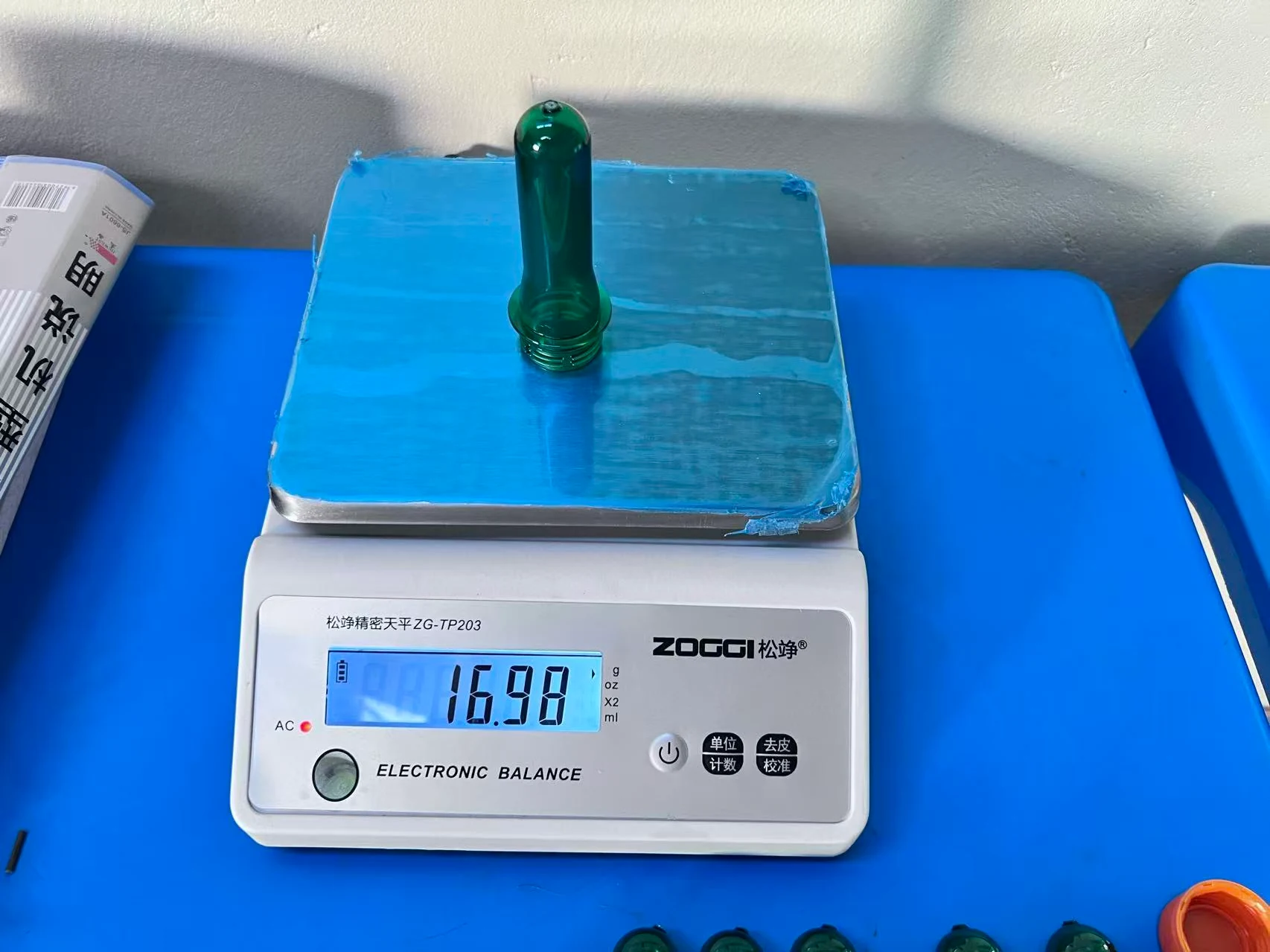
As a reference, preforms recorded on HWAMDA PET machines during customer mold trials range from about 10 g bottle preforms to 135 g edible-oil preforms, and include a 37 g wide-mouth preform. These are examples from specific molds, not recommended weights for your bottle.
What material are PET preforms made of?
Preforms are molded from bottle-grade PET, a polyester resin supplied as small pellets. Bottle grades have a higher molecular weight (intrinsic viscosity) than fibre grades, which gives the strength and clarity a stretched bottle needs.
Colour is added at the molding machine with masterbatch, for example amber, green, blue or white. Recycled PET (rPET) can be blended with new resin or used on its own; for food and drink bottles, it must come from a recycling process approved under the local food-contact rules.
PET absorbs moisture from the air. Wet PET loses molecular weight when it is melted, which can make preforms hazy and brittle, so the resin is always dried before molding.
PET preform vs PET bottle
The preform and the bottle are made of the same material and have the same neck. Everything below the neck changes during blowing.
| PET preform | PET bottle | |
|---|---|---|
| Shape | Short tube with a closed, rounded end | Final bottle shape and volume |
| Wall | Thick, to store material for stretching | Thin, after stretching |
| Neck finish | Final dimensions | Same as on the preform |
| How it is made | Injection molding | Stretch blow molding from the reheated preform |
| Shipping | Compact, packed in bulk | Bulky, normally blown close to the filling line |
| What can still change | Body shape and volume | Nothing: ready to fill |
In two-stage production, preforms are molded, cooled and stored, then reheated and blown on a separate blow molder, often in another plant. In one-stage production, the preform is blown on the same equipment while it still holds heat from molding. Both use the same preform principle.
How are PET preforms made?
Dried PET resin is melted in an injection unit and injected through a hot runner into a multi-cavity mold. The preforms are cooled in the mold, removed by ejection or a robot, then inspected and packed. The full sequence, with cycle time and the equipment involved, is explained step by step in a separate article.
What makes a good PET preform?
A good preform matches its drawing and blows into a good bottle. Five basics are checked on every production run:
- Weight
- Within the agreed tolerance, for the whole shot and for each cavity.
- Neck dimensions
- Thread, sealing surface and support ring within the finish drawing, so the cap fits and seals.
- Clarity and colour
- No white haze, streaks or colour difference between cavities.
- No contamination or bubbles
- No black specks, foreign particles or bubbles in the wall.
- Gate
- Short, clean and free of holes or white crystallised areas.
Planning a preform project?
Whether you plan to buy preforms or produce them yourself, the same information defines the project. Prepare these items before you ask for preforms, tooling or equipment:
- Neck finish
- The finish name and drawing, or the cap you will use.
- Preform weight
- Target weight and tolerance, or the bottle you want to match.
- Bottle volume and product
- Water, carbonated drink, oil, hot-fill or another product.
- Resin
- Bottle-grade PET, any rPET share, and colour.
- Quantity
- Required preforms per hour or per year, or a target cavity count.
- Sample or drawing
- A preform sample, a bottle sample or a preform drawing.
FAQ
Frequently asked questions
What is the difference between a preform and a bottle?
A preform is the thick-walled, test-tube-shaped part made by injection molding. A bottle is made from it by reheating and stretch blow molding. Both have the same neck finish; only the body changes.
Why are PET bottles made from preforms instead of being molded directly?
Injection molding cannot form a thin, hollow bottle behind a narrow neck. Stretching a preform during blowing also orients the PET, which gives a strong, clear bottle with less material. Preforms are also far cheaper to ship than empty bottles.
What does a neck finish like PCO 1881 mean?
It is the name of a standard neck finish, published by the International Society of Beverage Technologists (ISBT) and widely used for carbonated drinks and water. The name fixes the thread and sealing dimensions, so any cap made for PCO 1881 fits a PCO 1881 neck.
How heavy is a PET preform for a 500 ml bottle?
It depends on the product, the bottle design and the neck finish: a carbonated-drink bottle normally needs a heavier preform than a still-water bottle of the same size. Confirm the weight with your bottle design and closure. For reference, HWAMDA's customer mold-trial records include bottle preforms of 10, 12, 13, 15.2 and 16.5 g, but the bottle sizes they were made for depend on each customer's project.
Can PET preforms be made from recycled PET (rPET)?
Yes. rPET can be blended with new resin or used on its own. For food and drink bottles it must come from a recycling process approved under local food-contact rules, and it must be dried like new PET.
Are preforms shipped and blown elsewhere?
Often, yes. In two-stage production, preforms are molded in one plant, packed in bulk and shipped to the bottler, who reheats and blows them next to the filling line. Some bottlers mold their own preforms in the same plant.