 HWAMDA
Pipe fitting products
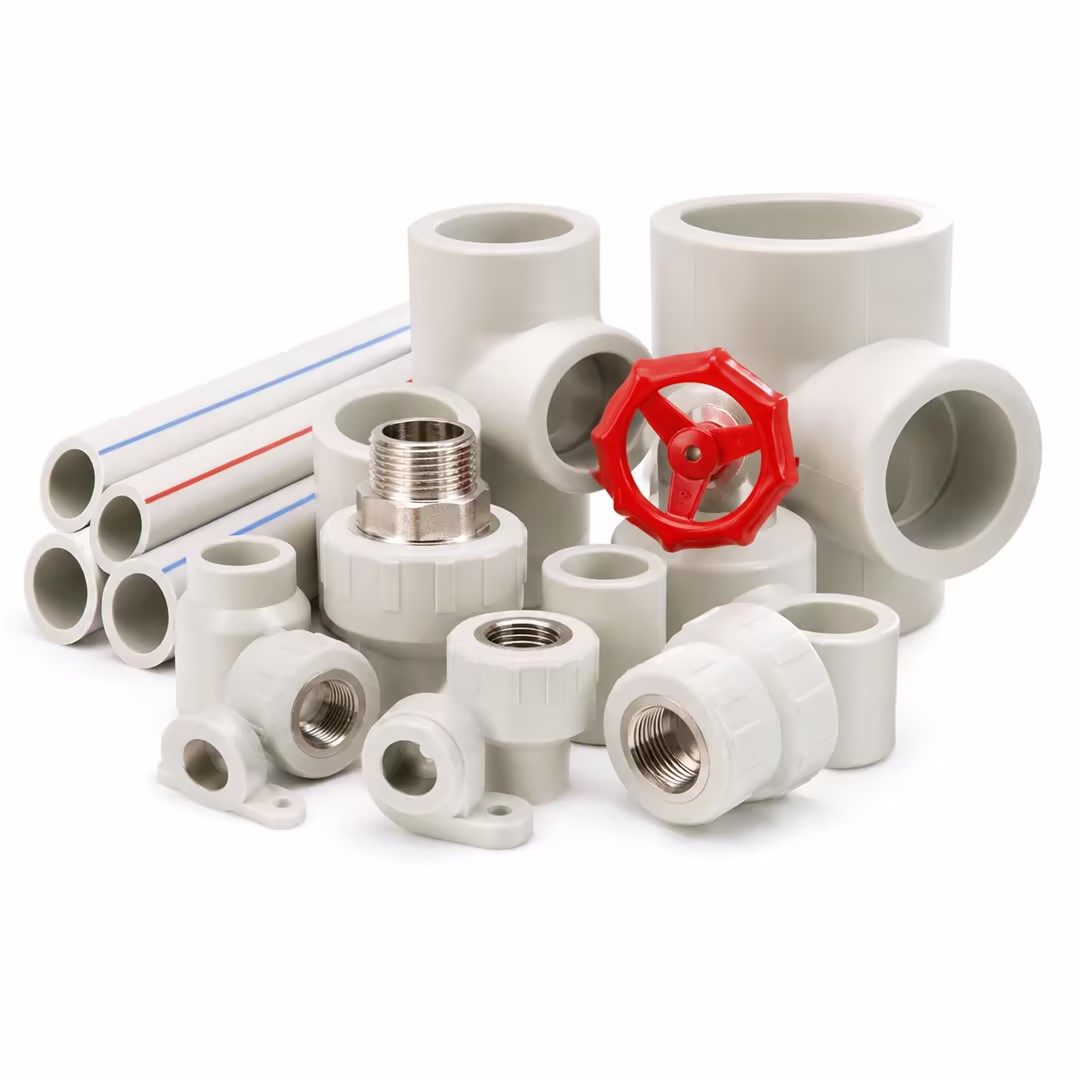
Pipe fittings connect water supply, drainage, irrigation, electrical conduit and building services systems. They are thick-walled, dimensionally critical parts, often with internal threads, sockets or metal inserts, molded in molds with hydraulic core pulls.
- Pressure fittings
- Elbows, tees, couplings, reducers and end caps for PVC-U and PPR water supply systems.
- Drainage and sewer fittings
- Larger-diameter PVC elbows, branches and traps, often with long cores and heavy molds.
- PPR fittings with inserts
- Threaded brass inserts molded into PPR for transition to metal pipework.
- Valves and conduit
- Ball valve bodies, unions and electrical conduit accessories in PVC or PP.
Materials and processing windows
| Material | Typical melt temperature | Key consideration |
|---|---|---|
| Rigid PVC (PVC-U) | Approx. 170–200 °C | Heat-sensitive; risk of degradation and corrosive HCl release if overheated or held too long |
| PPR | Approx. 200–250 °C | Thick walls and inserts; long cooling and shrinkage control |
| PP / PP-B | Approx. 200–240 °C | Conduit, drainage and irrigation fittings |
| ABS / PE | Material dependent | Special fittings and conduit accessories |
Processing windows vary by compound; confirm with your material supplier.
Process challenges
- PVC thermal stability
- Rigid PVC needs low-shear plasticizing, accurate barrel temperature control and short residence time. A PVC-specific screw, barrel and nozzle with corrosion-resistant treatment is standard practice.
- Core pulling
- Elbows and tees need several hydraulic core pulls with a safe sequence. The machine must provide enough core-pull circuits and interlocks for the mold.
- Thick walls and shrinkage
- Wall thicknesses of 3–8 mm or more lead to long hold and cooling times; sink marks and voids are controlled with holding pressure and cooling design.
- Inserts
- Metal inserts in PPR fittings require insert loading time, stable mold temperature and sometimes insert preheating.
- Dimensional accuracy
- Socket diameters and thread dimensions must meet pipe system standards for a reliable joint.
Typical configurations
HWAMDA pipe fitting machines are offered in separate configurations for PVC and for PPR/PP. PVC configurations use a PVC-specific plasticizing package with suitable temperature control. PPR and PP fittings run on the servo-hydraulic M8SII platform with the injection unit and core-pull circuits matched to the mold. Large drainage fittings with heavy molds may call for larger M8SII models.
A typical cell includes the machine, a mold temperature controller or chiller, a hopper loader, and a granulator for runners. PVC plants should also plan workshop ventilation around the machine.
Standards and quality checks
Fittings must join pipes reliably for decades, so producers work to national or international standards for pipe systems, for example ISO, EN, ASTM or DIN series for PVC-U and PPR. These standards define socket dimensions, wall thickness, pressure rating and test methods.
Typical production checks include socket and thread gauging, weight control, visual inspection for voids, burns and flow lines, and periodic hydrostatic pressure testing. For PVC, heat reversion or oven tests reveal processing stress. Stable machine repeatability and consistent material preparation make these checks easier to pass shot after shot.
Mold and cavity planning
| Fitting type | Typical mold concept | Machine consideration |
|---|---|---|
| Small elbows and tees (20–32 mm) | Multi-cavity with hydraulic cores | Core-pull circuits and shot weight |
| Medium pressure fittings (40–110 mm) | Two to four cavities | Mold size and plasticizing rate |
| Large drainage fittings (110 mm and above) | One or two cavities, long cores | Opening stroke, platen size, core-pull force |
| PPR fittings with inserts | Multi-cavity with insert pins | Insert loading time and mold temperature |
How to start
Send the fitting drawings or samples, sizes and standards, the material grade, part weight, mold dimensions and core-pull requirements, cavity count and target output. Existing molds can be reviewed for machine fit from their drawing and weight.
FAQ
Frequently asked questions
Do PVC fittings need a special injection molding machine?
PVC requires a plasticizing package designed for rigid PVC, with a low-shear screw, corrosion-resistant barrel and accurate temperature control. HWAMDA offers PVC-specific configurations for this purpose.
Can the same machine run PVC and PPR fittings?
PVC and PPR/PP are configured separately because their screws, temperature control and corrosion requirements differ. Plants producing both usually dedicate machines to each material.
How many core pulls does a fitting mold need?
Elbows and tees typically need two to three hydraulic cores, and complex branches more. The machine is configured with enough core-pull circuits for the mold.
Can you mold PPR fittings with brass inserts?
Yes, insert molding is common for threaded PPR fittings. Insert loading, mold temperature and cycle planning are part of the configuration review.
What should I send for a machine recommendation?
Fitting drawings or samples, material grade, part weight, mold size, core-pull data, cavity count and target output.