 HWAMDA
Four Ways to Classify Injection Molding Machines
Injection molding machines are classified in several overlapping ways. The drive system describes how the machine generates motion and force. The clamp design describes how the mold is opened, closed and held shut. Orientation describes whether the machine is horizontal or vertical. Application describes the specialized configurations built for packaging, preforms, multi-material parts, PVC and very large parts.
A single machine belongs to one category in each group. For example, a servo-hydraulic, toggle-clamp, horizontal machine configured for thin-wall packaging. Understanding each classification helps you compare offers and choose the configuration that suits your part, mold and output.
Types by Drive System
Drive choice affects energy use, precision, purchase price and maintenance. Hydraulic and servo-hydraulic machines handle high forces, core pulls and large molds easily. All-electric machines excel at repeatability and cleanliness but cost more per ton and are less common at large tonnages. Servo-hydraulic machines cover the widest range of applications at a balanced cost of ownership.
- Conventional hydraulic
- A constant-speed electric motor drives a fixed or variable-displacement pump. Robust and powerful, but the pump runs continuously, which raises energy use and oil temperature during cooling and idle phases.
- Servo-hydraulic
- A servo motor drives the pump and changes speed with demand, delivering oil only when the cycle needs it. It keeps hydraulic force and durability while cutting idle energy use and reducing oil heating. This is the most widely used drive for general-purpose and packaging machines today.
- All-electric
- Each axis (injection, plasticizing, clamp, ejector) is driven by its own servo motor and ball screw or belt. Very repeatable and clean, with low idle consumption. Most common in small and medium tonnages for precision, medical and electronics parts.
- Hybrid
- Combines electric and hydraulic axes, for example electric screw rotation with hydraulic injection and clamp, or an electric clamp with a hydraulic injection unit. Used where a specific axis benefits from electric precision or parallel movement.
Types by Clamping System
Toggle machines dominate up to medium-large tonnage because they are fast and economical. Above roughly 6,000 to 8,000 kN, two-platen machines become attractive for large molds that need long opening strokes and wide platens, such as bins, pallets, crates and automotive bumpers and panels.
- Toggle clamp
- A hydraulic cylinder or servo motor drives a linkage that multiplies force and locks the mold. Toggles give fast, smooth movement and are energy efficient. The five-point double toggle is the standard in small and medium machines.
- Direct hydraulic clamp
- A large central cylinder applies clamping force directly. Force is easy to adjust and evenly distributed, but large oil volumes are needed and movement is usually slower than a toggle.
- Two-platen clamp
- Short clamping cylinders, often integrated in the fixed platen, apply force through the tie bars, which are locked to the moving platen by split nuts. Removing the toggle and rear platen shortens the machine and increases mold opening space, which makes two-platen designs efficient at large tonnage.
Types by Orientation: Horizontal and Vertical
Horizontal machines open the mold horizontally, and parts fall or are removed by robot under gravity. They are easy to automate, suit high output and make up the large majority of installed machines.
Vertical machines open the mold vertically. Gravity holds inserts in place, which suits insert molding and overmolding of metal parts, cables and electronic components. Rotary or shuttle tables allow loading of inserts while the previous cycle runs. Vertical machines are typically smaller in tonnage and are chosen for insert work rather than high-volume packaging.
Types by Injection Unit Design
Most modern machines use a reciprocating screw: the screw rotates to melt and meter the material, then moves forward as a ram to inject it. This single-stage design gives good melt quality and accurate shot control for the vast majority of thermoplastics.
Two-stage or screw-plunger units separate the jobs. A screw plasticizes the material continuously and feeds it into a separate shooting pot, from which a plunger injects it. This allows plasticizing to continue during injection and holding, which helps with very large shots and some high-output preform applications. The trade-off is a more complex melt path that must be purged carefully during material changes.
Within reciprocating-screw machines, the injection unit size is itself a key variable. Many manufacturers offer several screw diameters on the same clamp so the shot volume and injection pressure can be matched to the part. On the HWAMDA M8SII series, A, B, C and D injection unit options are available per model, and the DP multi-material series pairs two or three units on one clamp, for example the HMD-DP410 with a 785 g A unit and a 932 g B unit (PS).
What the Differences Mean in Production
| Production factor | How machine type affects it |
|---|---|
| Energy use | Servo-hydraulic and all-electric drives reduce idle consumption compared with constant-speed hydraulic pumps |
| Cycle time | Toggle clamps and high-speed configurations give short dry cycles; parallel movements shorten the cycle further |
| Floor space | Two-platen machines are shorter than toggle machines of the same tonnage |
| Mold change | Large platens and long strokes on two-platen machines simplify handling of big molds |
| Core pulls and hydraulic functions | Hydraulic and servo-hydraulic machines provide them easily from the main power unit |
| Maintenance | Hydraulic machines need oil and filter care; electric axes need ball screw and belt care |
Types by Application
- High-speed thin-wall machines
- Built for cups, food containers, lids and IML packaging. They combine high injection rates, fast clamp movement, rigid platens and short dry cycles to fill walls below about 0.7 mm in fractions of a second.
- PET preform machines
- Configured with a long L/D PET screw, high plasticizing rate and a clamp suited to multi-cavity hot runner preform molds with post-mold cooling.
- Multi-material machines
- Two or three injection units feed one mold to produce two-color or two-material parts, such as soft-touch handles, multi-color closures and household items.
- PVC machines
- Equipped with low-compression screws, corrosion-resistant barrels and precise temperature control to process rigid PVC for pipe fittings without degradation.
- Large-tonnage machines
- Usually two-platen designs with large platens, long strokes and high shot capacity for logistics, automotive and industrial parts.
Comparison of Injection Molding Machine Types
| Type | Typical tonnage | Strengths | Typical applications |
|---|---|---|---|
| Conventional hydraulic | Small to very large | High force, robust, simple | General molding, older installations |
| Servo-hydraulic | Small to very large | Hydraulic force with lower energy use, versatile | General purpose, packaging, automotive, household |
| All-electric | Mostly small to medium | Precision, cleanliness, low idle energy | Medical, electronics, precision parts |
| Hybrid | Small to large | Combines electric precision and hydraulic force | Packaging and technical parts |
| Toggle clamp | Small to medium-large | Fast, efficient clamping | Most general-purpose machines |
| Two-platen | Large to very large | Compact length, large mold space | Bins, pallets, automotive parts |
| Vertical | Mostly small | Easy insert loading | Insert molding, overmolding |
| High-speed thin-wall | Medium | Very fast injection and dry cycle | Cups, containers, IML packaging |
| PET preform | Medium to large | PET plasticizing, multi-cavity molds | Bottle preforms |
| Multi-material | Small to large | Two or three injection units | Two-color and two-material parts |
Which HWAMDA Series Fits Each Type
HWAMDA builds machines across servo-hydraulic general-purpose, high-speed thin-wall, two-platen, multi-material and application-specific configurations. Each machine is assembled in Ningbo with CNC-machined key components and is production-tested before shipment.
| Machine type | HWAMDA series | Range |
|---|---|---|
| Servo-hydraulic, toggle, general purpose | M8SII | 25 models, 900 to 33,000 kN, A/B/C/D injection units |
| High-speed thin-wall | SP6 | 3,080 to 5,500 kN |
| PET preform | PET preform machines on the M8SII platform | Five sizes, 25:1 PET screw, 16 to 96 cavity molds |
| Two-platen, large tonnage | DU II | 6,500 to 24,000 kN, plus DU3300II for large molds |
| Multi-material | DP | 2,180 to 8,000 kN, two- or three-color/material |
| PVC | PVC / PPR / PP pipe fitting machines | PVC-specific plasticizing package |
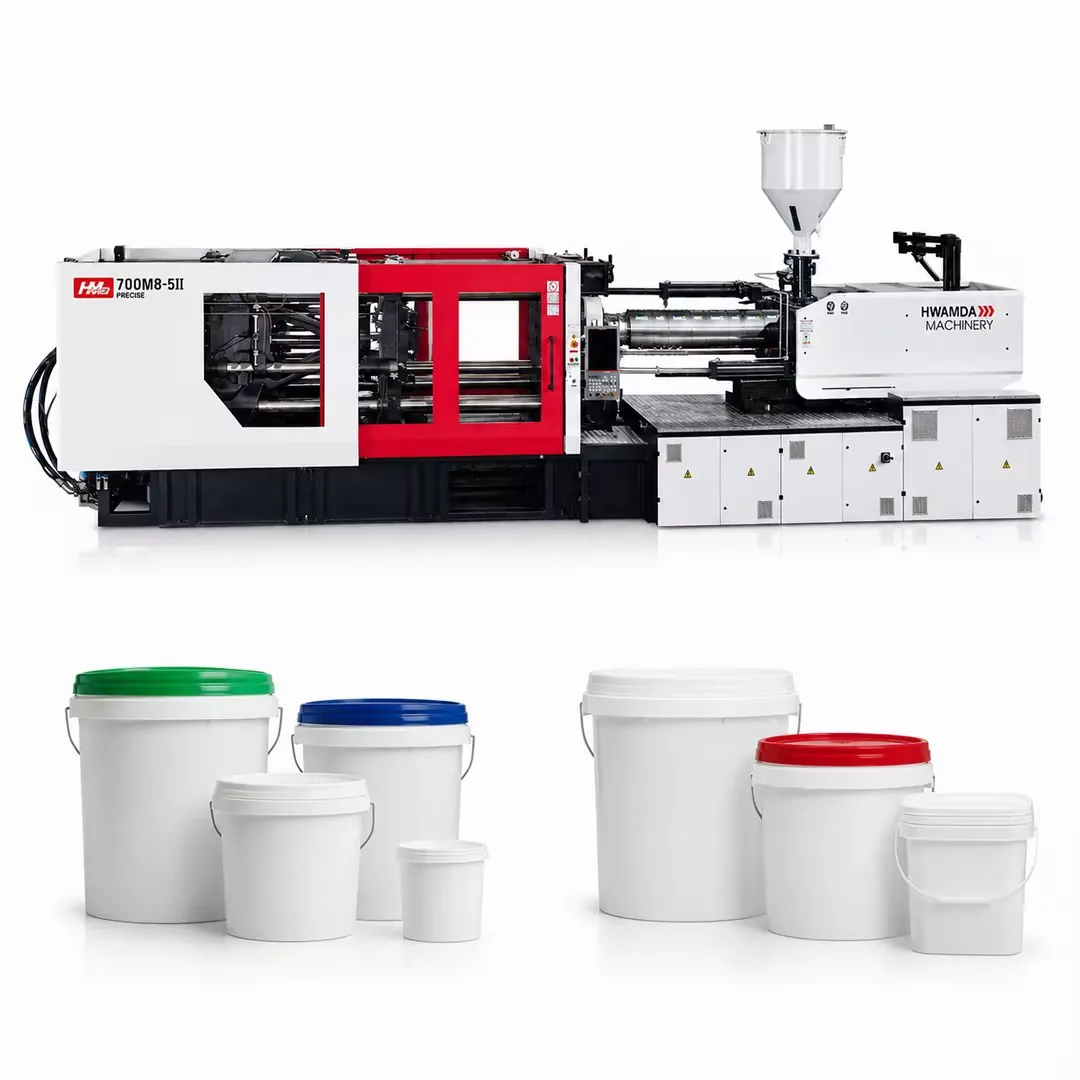
| Paint buckets | M8SII paint bucket series | HMD430 to HMD800M8-SII for 10 to 33 L buckets |
| Crates and baskets | FCII | HMD320 to HMD700FCII |
| Cosmetic packaging | M8-SII-P | Configured for cosmetic packaging |
How to Choose Between Machine Types
Start with the application. If the part is thin-wall packaging, a PET preform, a multi-material part or a PVC fitting, a specialized configuration will outperform a general-purpose machine. For everything else, a servo-hydraulic toggle machine is usually the most versatile and economical choice, with a two-platen design for large molds.
Then confirm the size with clamping force, shot size and mold fit calculations, and check the full cell: robots, IML, dryers, chillers and mold temperature controllers. HWAMDA's configuration consultation reviews part, mold and utilities together to recommend the series and model that match your project.
FAQ
Frequently asked questions
What is the most common type of injection molding machine?
The horizontal toggle-clamp machine with a hydraulic or servo-hydraulic drive is the most common type, used across packaging, household, automotive and industrial parts.
What is the difference between hydraulic and servo-hydraulic machines?
Both use hydraulic cylinders, but a servo-hydraulic machine drives the pump with a servo motor that runs only as fast as the cycle demands. This lowers energy use and oil heating compared with a constant-speed pump.
When should I choose a two-platen machine?
Two-platen machines suit large tonnages and large molds, typically above 6,000 to 8,000 kN, where their compact length and long opening stroke are an advantage.
Are all-electric machines better than servo-hydraulic machines?
Not in every case. All-electric machines offer precision and cleanliness, mostly in smaller sizes, while servo-hydraulic machines provide high force, easy core pulls and a wider tonnage range at a balanced cost.
What is a vertical injection molding machine used for?
Vertical machines are mainly used for insert molding and overmolding, where gravity keeps metal inserts or components in place in the lower mold half.
Do I need a special machine for thin-wall packaging?
For walls below about 0.7 mm and high-output cups or containers, a high-speed thin-wall machine such as the HWAMDA SP6 series gives the injection rate and fast cycle that standard machines lack.
What machine is used for PET preforms?
PET preforms need a machine with a long L/D PET screw, high plasticizing rate and a clamp suited to multi-cavity hot runner molds. HWAMDA builds PET preform machines on the M8SII platform with a 25:1 PET screw.
Can one machine handle two colors or materials?
Yes, a multi-material machine with two or three injection units can mold two-color or two-material parts in one cycle. HWAMDA's DP series covers 2,180 to 8,000 kN.