 HWAMDA
Purchase price is only the start
A used injection molding machine can cost a fraction of a new one, which makes it attractive for startups, overflow capacity or short-term projects. But the purchase price is only one line in the total cost of ownership. Energy, repairs, spare parts, downtime, scrap, installation and retrofits often decide whether a deal is good.
This guide explains how to compare the two options on total cost, what to inspect on a used machine, the risks to price in, and what you should expect when you buy new from a manufacturer.
The goal is not to rule out used equipment. It is to make sure the comparison includes every cost and risk, so the machine you choose delivers the lowest cost per good part over the years you plan to run it.
Price vs total cost of ownership
Over a typical service life of 10 to 15 years, energy and maintenance can exceed the original machine price. An older fixed-pump hydraulic machine typically uses 0.8 to 1.2 kWh per kilogram of processed material, while a modern servo-hydraulic machine is often in the 0.4 to 0.7 kWh/kg range. At several hundred tonnes of material per year, that difference adds up quickly.
Also count the costs that do not appear on the invoice: dismantling and transport from the seller, rigging, reconnection, refurbishment of worn plasticizing parts, new safety components, operator time spent learning an unfamiliar control, and the risk of unplanned downtime during the first months.
| Cost item | Used machine | New machine |
|---|---|---|
| Purchase price | Lower | Higher |
| Energy per kg | Often higher on older hydraulics | Lower with servo-hydraulic drives |
| Refurbishment | Screw, barrel, seals, heaters often needed | None at start |
| Spare parts | Availability depends on age and original maker | Available from the manufacturer |
| Commissioning and training | Usually arranged by the buyer | Typically offered by the manufacturer |
| Downtime risk | Higher, history often unknown | Lower, known history |
| Resale value | Already depreciated | Holds value with good records |
Used machine inspection checklist
Inspect the machine under power and, if possible, molding a real part. A machine that cannot be run is a much higher risk.
| Area | What to check | Warning signs |
|---|---|---|
| Documentation | Serial plate, manuals, electrical and hydraulic diagrams, service history | No documents, removed nameplate |
| Operating hours | Hour meter and cycle counter on the controller | Very high hours with no overhaul record |
| Clamp unit | Platen parallelism, tie-bar wear and bending, toggle pin and bushing play | Uneven tie-bar wear, toggle knocking, cracks near platen corners |
| Plasticizing unit | Screw OD, barrel ID, check ring, nozzle | Unstable cushion, long recovery time, black specks |
| Hydraulics | Oil condition, leaks, pump noise, oil temperature after an hour of running | Dark or milky oil, rising temperature, whining pump |
| Electrical and control | Cabinet condition, controller model, display, alarm history | Burned terminals, obsolete controller, missing boards |
| Heaters and thermocouples | All zones heat and hold setpoint | Zones that drift or never reach temperature |
| Safety | Gates, interlocks, E-stops, mechanical safety bar, guards | Bypassed switches, missing guards |
| Process test | Shot weight consistency over 20 to 50 cycles, clamp force check | Weight variation, flash at rated clamp force |
Risks to price into a used machine
- Control obsolescence
- Controllers and servo drives from 15 or more years ago may have no available replacement boards. A failed controller can mean a costly retrofit or a scrapped machine.
- Spare parts availability
- Parts for discontinued models or makers that have exited the market can take weeks to source or must be custom-made.
- Energy consumption
- Fixed-pump hydraulics and older heater technology raise energy costs for the remaining life of the machine.
- Safety compliance
- Machines imported into regions such as the EU must meet current requirements, including CE conformity. Older machines may need guarding, interlock and electrical upgrades before they can legally run.
- Hidden wear
- Worn screws, cracked platens and tired pumps are not always visible on a short inspection, and refurbishment costs can erase the price advantage.
Refurbished and rebuilt machines
Between new and as-is used machines sits the refurbished machine. A genuine rebuild typically includes a new or reconditioned screw, barrel and check ring, new seals and hoses, fresh hydraulic oil and filters, replaced heater bands and thermocouples, and a functional test. Some rebuilds also add a new controller or servo pump retrofit.
Ask exactly what was replaced, request the parts list and test records, and confirm who supports the machine afterward. A thorough rebuild narrows the risk gap with a new machine, but it also narrows the price gap, so compare the final offer against a new machine of the same size.
A simple cost comparison example
Consider a 250 t machine processing 150 tonnes of PP per year. If an older fixed-pump machine uses 1.0 kWh/kg and a new servo-hydraulic machine uses 0.55 kWh/kg, the difference is 0.45 kWh/kg, or 67,500 kWh per year. Multiply that by your local electricity tariff and by the years you expect to run the machine to see the energy cost alone.
Then add the expected refurbishment of the used machine, such as screw and barrel, seals and heaters, plus a contingency for unplanned downtime. In many cases, the price advantage of the used machine is recovered by the new machine within a few years of steady production.
Depreciation and financing
Machines lose most of their value in the first years, so a used machine has already absorbed much of its depreciation. That is attractive for cash flow, but it also means less remaining book value to depreciate for tax purposes, depending on local rules.
New machines are generally easier to finance through leasing or equipment loans because lenders value a known asset with documentation and a long remaining life. Some regions also offer incentives for energy-efficient equipment. Discuss the options with your accountant and lender before deciding on price alone.
When a used machine makes sense
- Short projects or prototypes
- Low-volume or short-life products where payback time must be very short.
- Simple, tolerant parts
- Parts with wide tolerances and long cycles where precision and speed are not critical.
- Strong in-house maintenance
- A maintenance team experienced with the specific make and model, with access to parts.
- Known history
- A machine bought from a known operation with full service records and a run-off you can witness.
When a new machine makes sense
- Core production capacity
- Machines that will run high volumes for many years, where energy, uptime and repeatability drive cost per part.
- Demanding applications
- Thin-wall packaging, PET preforms, IML and high-cavitation molds need speed, precision and modern control.
- New molds and turnkey projects
- Machine and mold can be matched and tested together before shipment.
- Export and compliance
- Production for markets with strict safety and documentation requirements.
What a new machine from a manufacturer includes
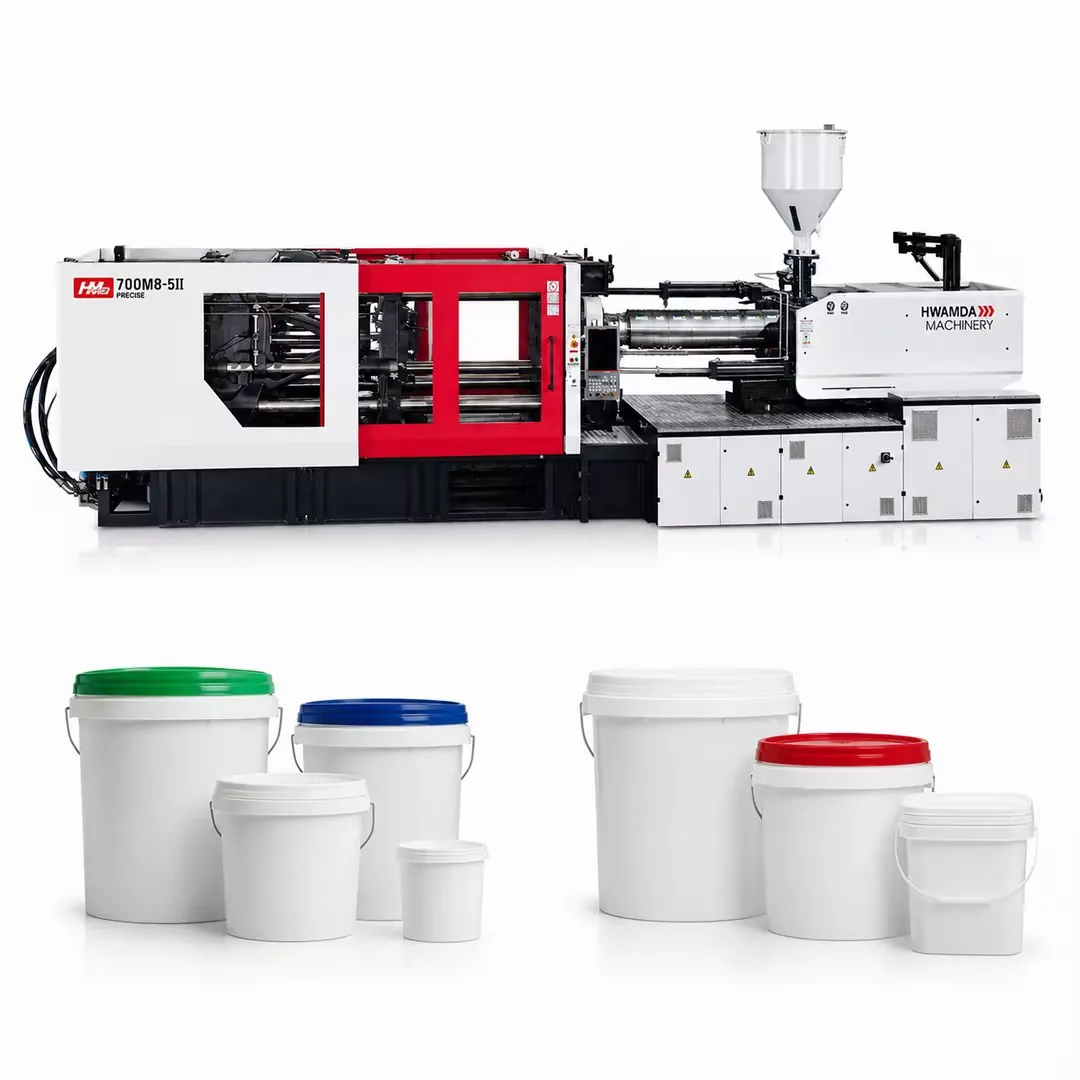
Buying new from the manufacturer gives you more than an unused machine. With HWAMDA, a typical project includes configuration consultation to match clamp force, shot size and options to your part and mold, and factory inspection and trial before shipment against agreed acceptance requirements.
Delivery comes with operating manuals, electrical and hydraulic diagrams and the relevant conformity records, such as CE/SGS assessment and EAC declaration where applicable. HWAMDA also supports shipping preparation, installation and commissioning, operator training, spare parts, maintenance guidance and remote technical support. Machines are produced with Mitsubishi, Mazak and Okuma CNC machining, five-axis machining of key components and production testing before shipment.
Questions to ask any seller
- What is the machine's full history?
- Year of manufacture, operating hours, applications run, materials processed and service records.
- Can I see it running?
- Ask for a run-off on a real mold, ideally your own, and measure shot weight consistency.
- What documentation is included?
- Manuals, diagrams, parts lists and conformity records for your market.
- How are spare parts supplied?
- Which parts are stocked, how they are shipped and how long the model will be supported.
- What support is offered after delivery?
- Installation, commissioning, training and remote technical support.
- What are the acceptance requirements?
- Agree in writing on what will be tested and what results count as accepted before shipment.
FAQ
Frequently asked questions
Is a used injection molding machine worth buying?
It can be for short projects, simple parts or overflow capacity, provided the machine is inspected under power, has known history and spare parts are available. For core production, a new machine usually wins on total cost.
How old is too old for a used injection molding machine?
Age matters less than condition and support. Machines with obsolete controllers or no spare parts source are high risk regardless of age, and those over 15 years old often face both issues.
What should I inspect first on a used machine?
Check documentation and operating hours, then run the machine and check the plasticizing unit, clamp parallelism, hydraulic oil condition, controller alarms and safety functions.
How much more energy does an old hydraulic machine use?
Typical values are 0.8 to 1.2 kWh/kg for older fixed-pump hydraulics compared with roughly 0.4 to 0.7 kWh/kg for modern servo-hydraulic machines, depending on the cycle.
Can a used machine be imported into the EU?
It must meet current safety requirements and carry CE conformity. Older machines may need guarding, interlock and electrical upgrades before they can be placed in service.
What support comes with a new HWAMDA machine?
HWAMDA projects include configuration consultation, factory trial before shipment against agreed acceptance requirements, installation and commissioning, operator training, spare parts, maintenance guidance and remote technical support.
Is financing easier for new or used machines?
New machines are generally easier to finance through leasing or equipment loans because they have documentation, a known history and a long remaining service life.