 HWAMDA
Three drive concepts, one decision
Every injection molding machine has to close and clamp the mold, inject and pack the melt, rotate the screw for plasticizing, and eject the part. The drive concept that powers those movements shapes energy use, precision, speed, maintenance and investment for the life of the machine.
Today buyers choose between three main options: conventional hydraulic machines with fixed or variable displacement pumps, servo-hydraulic machines where a servo motor drives the pump, and all-electric machines where each axis has its own servo motor and mechanical drive. There is no universal winner. The right choice depends on part type, tonnage, cycle time and how energy and maintenance costs weigh in your factory.
The sections below explain how each drive works, compare them side by side, put typical energy figures in context and map common applications to the most suitable drive concept.
How hydraulic machines work
A hydraulic machine uses an electric motor to drive a pump that supplies pressurized oil to cylinders for clamping, injection and ejection, and to a hydraulic motor for screw rotation. Valves control flow and pressure for each movement.
In older fixed-pump designs, the motor runs at constant speed throughout the cycle, even during cooling when little or no oil is needed. Excess flow is throttled or returned to the tank as heat, which increases energy use and cooling water demand. Hydraulics are, however, very robust, deliver high force easily and scale well to large clamping forces.
How all-electric machines work
All-electric machines replace hydraulic cylinders with servo motors connected to ball screws, toothed belts and toggle mechanisms. Each axis is controlled directly by its own servo, so motion is precise and power is drawn only when an axis moves.
The benefits are excellent repeatability, low energy use, quiet operation and no hydraulic oil in the clamp or injection system, which suits cleanroom work. The trade-offs are higher investment, ball screws and bearings that are costly wear parts, and practical limits at high clamping forces and long holding-pressure phases where servo motors must hold torque.
Servo-hydraulic: the middle option
Servo-hydraulic machines keep the proven hydraulic actuators but drive the pump with a servo motor. The pump speed follows the demand of each phase of the cycle and drops close to zero during cooling. This cuts energy use, reduces oil heating and lowers noise, while keeping the force density and robustness of hydraulics.
In typical industry comparisons, servo-hydraulic machines use roughly 30 to 60 percent less energy than fixed-pump hydraulic machines, depending on cycle profile, with all-electric machines lower still. Pressure and speed control are also more repeatable than on fixed-pump machines because the servo loop closes on pressure and flow. For most general-purpose molding, servo-hydraulic delivers the best balance of investment, energy and versatility.
Comparison table
| Criterion | Fixed-pump hydraulic | Servo-hydraulic | All-electric |
|---|---|---|---|
| Energy use | Highest | Typically 30 to 60% lower than fixed-pump | Lowest, often below servo-hydraulic |
| Precision and repeatability | Good | Very good | Excellent |
| Speed | Good; high speeds possible with accumulators | Good to very high with accumulator options | High, with parallel movements |
| Clamping force range | Small to very large | Small to very large | Mostly small to medium |
| Maintenance | Oil, filters, seals, valves | Oil, filters, seals plus servo drive | Ball screws, bearings, belts, lubrication |
| Noise | Higher | Lower, quiet during cooling | Lowest |
| Hydraulic oil | Yes, more heat | Yes, less heat | No oil in main drives |
| Investment | Lowest | Moderate | Highest |
| Large tonnage suitability | Strong | Strong | Limited and costly |
| Thin-wall packaging | Possible with accumulators | Strong with accumulator injection | Good on smaller tonnage |
Energy figures are typical industry ranges. Actual results depend on cycle profile, part design and process settings.
What energy figures mean in practice
Energy is usually quoted as kWh per kilogram of processed material. Typical industry values are around 0.8 to 1.2 kWh/kg for older fixed-pump hydraulic machines, 0.4 to 0.7 kWh/kg for servo-hydraulic, and 0.3 to 0.5 kWh/kg for all-electric machines on comparable jobs. These numbers include drives but often exclude barrel heating, chillers and auxiliaries.
The biggest savings appear on cycles with long cooling or holding phases, where a fixed pump wastes energy and a servo pump idles. On very fast cycles with continuous movement, the gap narrows. When comparing quotes, ask for energy data on a cycle that resembles your own production.
Precision, speed and accumulators
Repeatability is usually judged by shot weight variation over many cycles. All-electric machines typically reach shot weight variation well below 0.5 percent thanks to direct position control of the screw. Modern servo-hydraulic machines with closed-loop pressure and velocity control come close for most parts, while older fixed-pump machines show more drift as oil temperature changes during the shift.
Speed has two parts: injection speed and dry cycle. Thin-wall packaging with walls of 0.4 to 0.8 mm often needs injection speeds of several hundred mm/s, which hydraulic machines achieve with accumulators that store energy during the cycle and release it during injection. All-electric machines can move clamp, ejector and screw in parallel, which shortens cycles on small parts, while servo-hydraulic machines with separate drives or accumulators can also overlap movements.
Maintenance and lifetime cost
Hydraulic and servo-hydraulic machines need oil changes, filter replacement and seal maintenance, but the parts are standard, widely available and familiar to most maintenance teams. A well-maintained hydraulic clamp can run for decades. Servo-hydraulic machines add a servo drive and motor, which run cooler and quieter than a constantly running pump and usually extend oil and seal life.
All-electric machines avoid oil changes but rely on ball screws, linear guides, bearings and belts that require precise lubrication and are expensive to replace when worn. Their electronics also need clean, stable power and well-cooled cabinets. When comparing lifetime cost, include energy, cooling water, oil, wear parts and the skills your maintenance team already has.
Questions to answer before choosing
- What clamp force and mold size do you need?
- Above roughly 5,000 kN, hydraulic and two-platen designs usually offer the best value.
- How long are your holding and cooling phases?
- Long phases favor servo-driven pumps or all-electric drives over fixed pumps.
- What wall thickness and flow length?
- Thin walls need high injection speed and pressure, often with accumulator support.
- How expensive is electricity at your site?
- Higher tariffs shorten the payback on more efficient drives.
- What does your maintenance team know?
- Choose a technology your team can service quickly with locally available parts.
Decision guide by application
- General technical and household parts
- Servo-hydraulic is the usual choice: flexible, robust and energy efficient across a wide tonnage range.
- Thin-wall cups, food containers and IML packaging
- High injection speed and fast clamp movement are critical. A dedicated high-speed servo-hydraulic machine with accumulator injection handles thin walls and large cavitation well.
- PET preforms
- Long holding phases and high-cavitation molds suit servo-hydraulic machines with a PET-specific screw.
- Paint buckets, crates and logistics parts
- Large projected areas and heavy molds need high clamp force and robust platens, a strength of servo-hydraulic and two-platen designs.
- Large automotive and industrial parts
- Two-platen hydraulic machines offer large mold space, long opening strokes and a compact footprint at high tonnage.
- Small precision, medical and electronic parts
- All-electric machines are often preferred for repeatability and oil-free operation at low tonnage.
Where HWAMDA machines fit
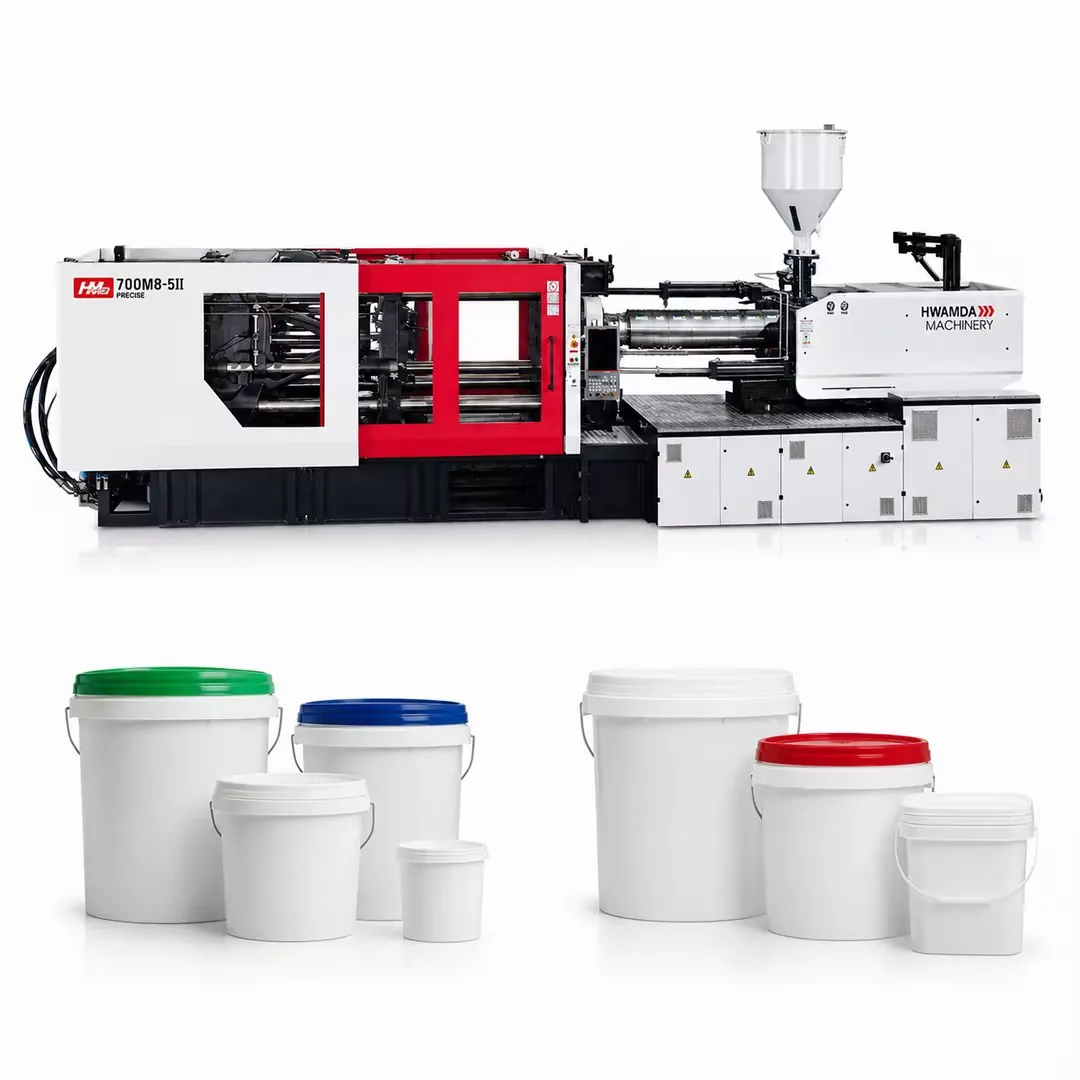
The HWAMDA M8SII servo-hydraulic series covers 25 models from 900 to 33,000 kN with several injection-unit options per model, so the clamp and shot can be matched closely to the part. It is the base for HWAMDA PET preform, paint bucket and crate machines as well.
For thin-wall packaging, the SP6 high-speed series (3,080 to 5,500 kN) is built for cups, thin-wall food containers and IML packaging, where fast injection and short dry cycles matter most. For large molds, the DU II two-platen series (6,500 to 24,000 kN, plus DU3300II) provides the mold space and clamp force that big parts require.
HWAMDA configuration consultation reviews the part, mold and utilities before recommending a model, and factory trials before shipment confirm performance against agreed acceptance requirements.
FAQ
Frequently asked questions
Are electric injection molding machines better than hydraulic?
Not in every case. All-electric machines lead on precision and energy at small and medium tonnage, while hydraulic and servo-hydraulic machines are more cost-effective and robust for large tonnage, heavy molds and long holding phases.
How much energy does a servo-hydraulic machine save?
In typical industry comparisons, servo-hydraulic machines use roughly 30 to 60 percent less energy than fixed-pump hydraulic machines. The exact figure depends on the cycle, especially the length of cooling and holding phases.
Is servo-hydraulic accurate enough for precision parts?
For most technical and packaging parts, yes. Closed-loop servo control of pressure and flow gives good repeatability. Very small, high-precision parts are often run on all-electric machines.
Which drive is best for thin-wall packaging?
Thin-wall parts need very high injection speed. High-speed servo-hydraulic machines with accumulator injection, such as the HWAMDA SP6 series, are widely used for cups, containers and IML packaging.
Why are large machines rarely all-electric?
High clamping forces and long holding pressure require very large servo motors and ball screws, which become expensive and harder to maintain. Hydraulic and two-platen designs scale more economically.
Do servo-hydraulic machines still need hydraulic oil maintenance?
Yes. They run cooler and stress oil less, but oil cleanliness, filter changes and periodic oil analysis remain essential.
What should I compare besides machine price?
Compare energy per kilogram on a representative cycle, maintenance costs, spare parts availability, required cooling capacity and the support offered for installation, training and service.