 HWAMDA
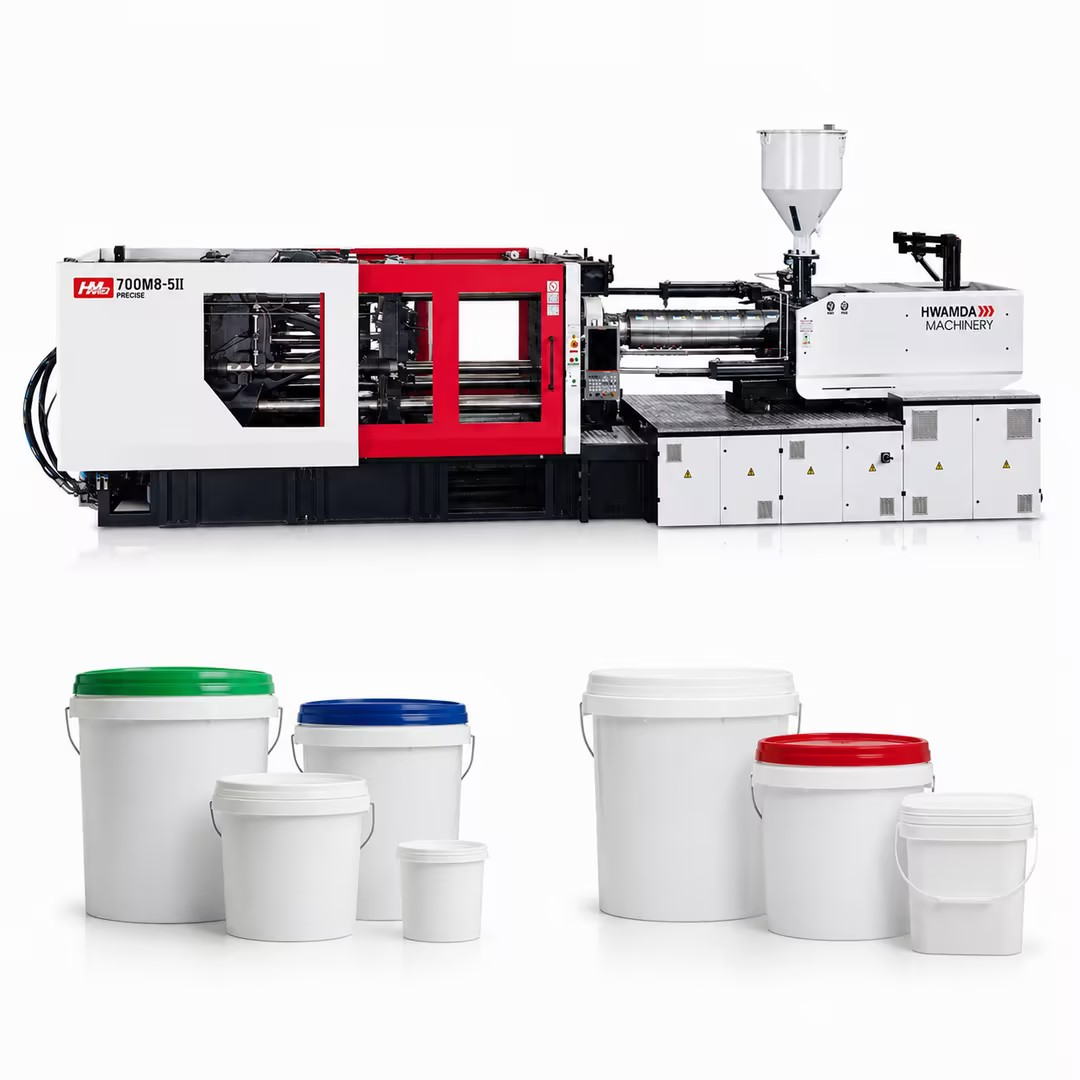
Paint bucket and pail products
Paint, coating, adhesive and chemical producers need buckets that stack, seal and survive filling, transport and drops. Typical products are round and square pails from 10 to 33 L with matching lids, handles and tamper-evident features. Many buckets are decorated by in-mold labeling (IML) so they leave the machine ready for filling.
- Round paint buckets
- 10, 15, 18, 20 and 25 L formats with steel or plastic handles and tamper-evident lids.
- Square and rectangular pails
- Better pallet utilization, with more demanding wall distribution and corner filling.
- Lids and closures
- Snap-on or tear-strip lids, often molded on a separate machine and mold to balance cycle times.
- Industrial and chemical pails
- Thicker walls, UN-rated designs or higher drop requirements for hazardous goods.
Materials
| Material | Typical use | Notes |
|---|---|---|
| PP copolymer (impact) | Most paint buckets and lids | Typical MFI 20–45 g/10 min; good low-temperature impact strength |
| PP homopolymer | Rigid lids, cost-sensitive buckets | Higher stiffness, lower impact at low temperature |
| HDPE | Chemical pails and UN-rated containers | Good chemical and drop resistance; higher shrinkage |
Confirm grade selection with your resin supplier against your filling and drop-test requirements.
Process challenges
- Flow length and wall distribution
- A 20 L bucket has a long flow path from the base gate to the rim. Typical wall thickness is 1.2–2.0 mm, so even mold cooling and core alignment are needed to keep walls uniform.
- Core shift and concentricity
- Uneven wall thickness weakens the bucket and causes stacking and sealing problems. Interlocks and balanced filling help keep the core centered.
- Deep demolding
- Tall buckets require long opening strokes and reliable air-assisted ejection, which drives machine stroke and daylight selection.
- Rim and lid sealing
- Rim geometry and lid fit determine leak tightness; shrinkage and warpage must be controlled at the rim.
- Cycle time
- Cooling dominates the cycle. Typical cycles run roughly 18–30 s depending on size, wall thickness and mold cooling.
Typical configurations
The M8SII paint bucket series covers HMD430 to HMD800M8-SII for 10–33 L buckets, configured for either three-axis robot take-out or IML. The paint bucket mold program covers the same capacity range, so the machine and mold can be matched in one project.
| Bucket size | Typical machine range | Handling |
|---|---|---|
| 10 L | HMD430–HMD500M8-SII | Robot take-out or IML |
| 15–18 L | HMD500–HMD600M8-SII | Robot take-out or IML |
| 18–25 L | HMD700M8-SII | Robot take-out or IML |
| 25–33 L | HMD800M8-SII | Robot take-out or IML |
The final model depends on the bucket geometry, mold dimensions, part weight and decoration route.
Production cell equipment
A complete paint bucket cell usually adds a chiller and mold temperature controller, vacuum loader and color dosing, a take-out or IML robot with stacking conveyor, and a granulator for runners and rejects. Lids are often produced on a smaller general-purpose M8SII machine. The IML automation solution page explains the label handling side of the cell.
Typical quality checks for buckets
Paint buckets are tested as packaging, not just as molded parts. Defining the checks early gives the mold design and process setup a clear target and makes factory trial acceptance straightforward.
- Weight and wall thickness
- Part weight within a tight band and wall thickness measured at several heights around the circumference.
- Drop test
- Filled buckets dropped from a defined height, often at low temperature, to check rim, base and handle strength.
- Stacking and top load
- Empty nesting without sticking, and filled stacking load without wall buckling.
- Lid seal and tamper evidence
- Leak test after closing, and a tear strip or tamper band that works consistently.
- Label quality
- For IML buckets, label position, adhesion and absence of wrinkles or air bubbles.
How to start
Send the bucket and lid drawing or samples, capacity, target weight, material grade, decoration method and required output. If you already own molds, add their dimensions and weight. A sales engineer will match the machine, mold and automation and propose the cell.
FAQ
Frequently asked questions
Which machine size do I need for a 20 L paint bucket?
Most 18–25 L buckets fit the HMD700M8-SII range, but the final choice depends on bucket geometry, mold size, weight and whether IML is used.
Can one cell produce both the bucket and the lid?
Buckets and lids usually run on separate machines and molds so that each cycle is optimized. Some projects use family molds; this is reviewed case by case.
Is IML or offset printing better for paint buckets?
IML gives high-quality, scratch-resistant decoration in one step and removes a separate printing process. Printing can suit frequent design changes or lower volumes.
Which material is used for paint buckets?
Impact PP copolymer is most common. HDPE is used for some chemical and UN-rated containers.
What information should I send for a quotation?
Bucket and lid drawings or samples, capacity, weight, material, decoration method, output target and any existing mold data.